Guide
LOT, BATCH, EXP and PAO: how cosmetic date marks work
A practical guide for reading product traceability marks on cosmetics and fragrances.
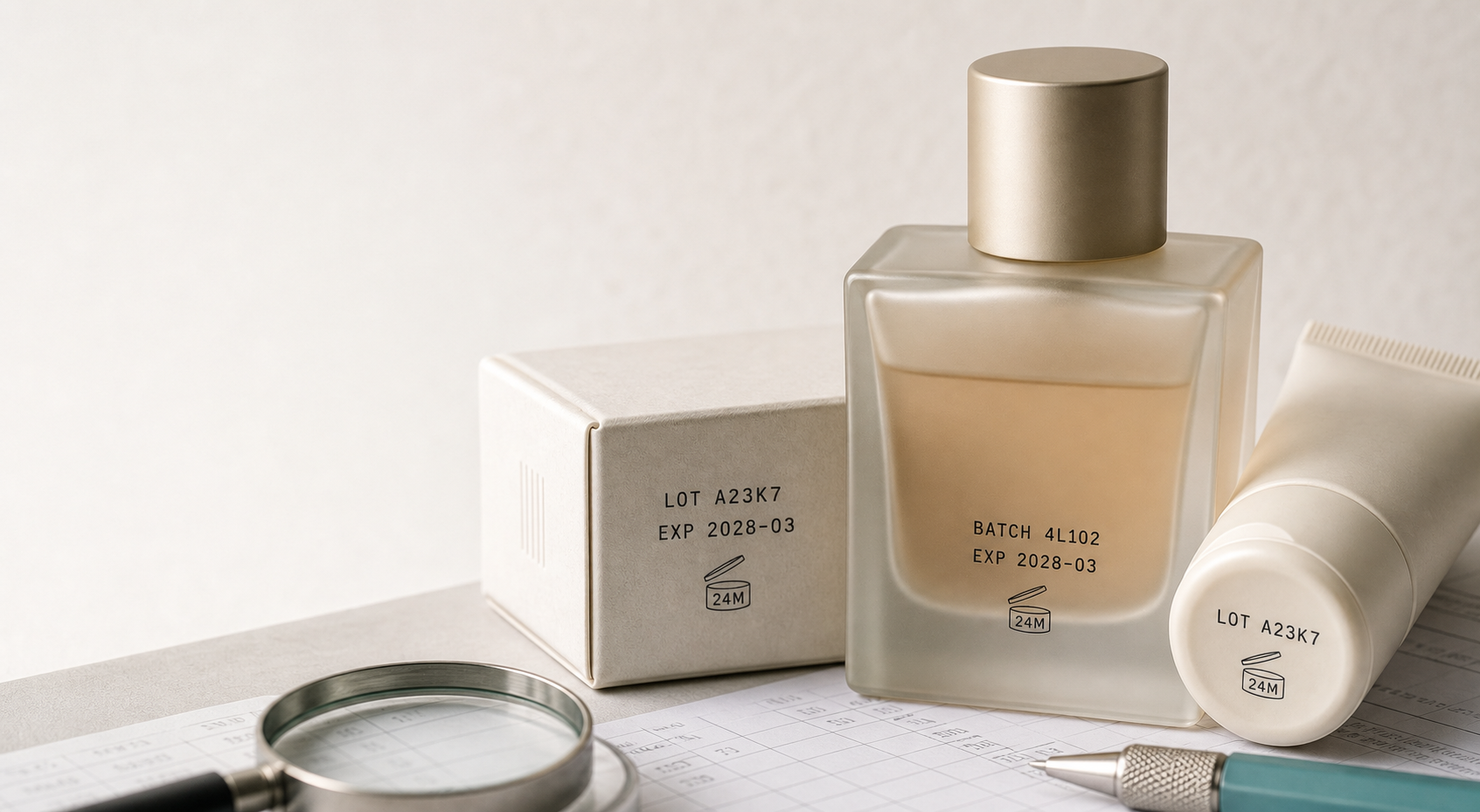
01 LOT / BATCH identifies production traceability
A LOT or BATCH code is a compact production-batch identifier. It may contain letters, digits, plant codes, line codes, and date fragments. The same visible pattern can mean different things depending on the brand.
02 Manufacturing date is not always printed directly
Some packages show an explicit EXP date, while others only show a batch code. When a brand rule is known, the code can often be converted into a manufacturing date and then used for an estimated expiry calculation.
03 Where to inspect the package
Check the bottle base, cap area, tube crimp, box flap, back label, sticker edge, or barcode area. Codes can be ink-printed, embossed, laser-marked, or stamped in low contrast.
04 How Cosmetic LOT interprets it
The service maps each supported brand to a decoder group, evaluates the rule against the entered LOT, and returns the recovered manufacturing date. If a rule is missing, the request form helps collect examples for review.
05 Use results with storage context
Shelf life is affected by storage, heat, sunlight, preservatives, and contamination risk after opening. Treat decoded dates as an inspection aid alongside the printed label and product condition.
Professional references
Cosmetic quality systems commonly rely on batch traceability. ISO 22716 describes GMP guidance for cosmetic production, control, storage and shipment, while FDA consumer guidance notes that storage and contamination can affect cosmetic shelf life.